
Most pieces are not hard everywhere. Usually one bar, or two, stops your child again and again. This guide shows how to find that bar and fix it in small steps, with the loop, tempo and one-hand tools in Pianu.
Why not play the whole piece again?
When a child plays the whole piece to practice one hard bar, most of the time goes to the easy parts. The hard bar gets a few seconds, and the mistake gets practiced again too.
If your child stops at the same place every time, that place needs its own practice. Small and slow first. Fast and whole later.
There is a second reason. Each time your child stops at the same bar, they also practice the stop. Soon the stop feels like part of the song. Fixing the bar on its own breaks that pattern.
How do I find the hard bar?
Listen to one play of the whole piece, and do not stop your child. Then ask:
- Where did they stop or slow down?
- Where did the wrong notes happen?
- Where did the rhythm get uneven?
The feedback after a play in Pianu helps you find the place where it went wrong. Read a first practice in Pianu to see what the feedback shows.
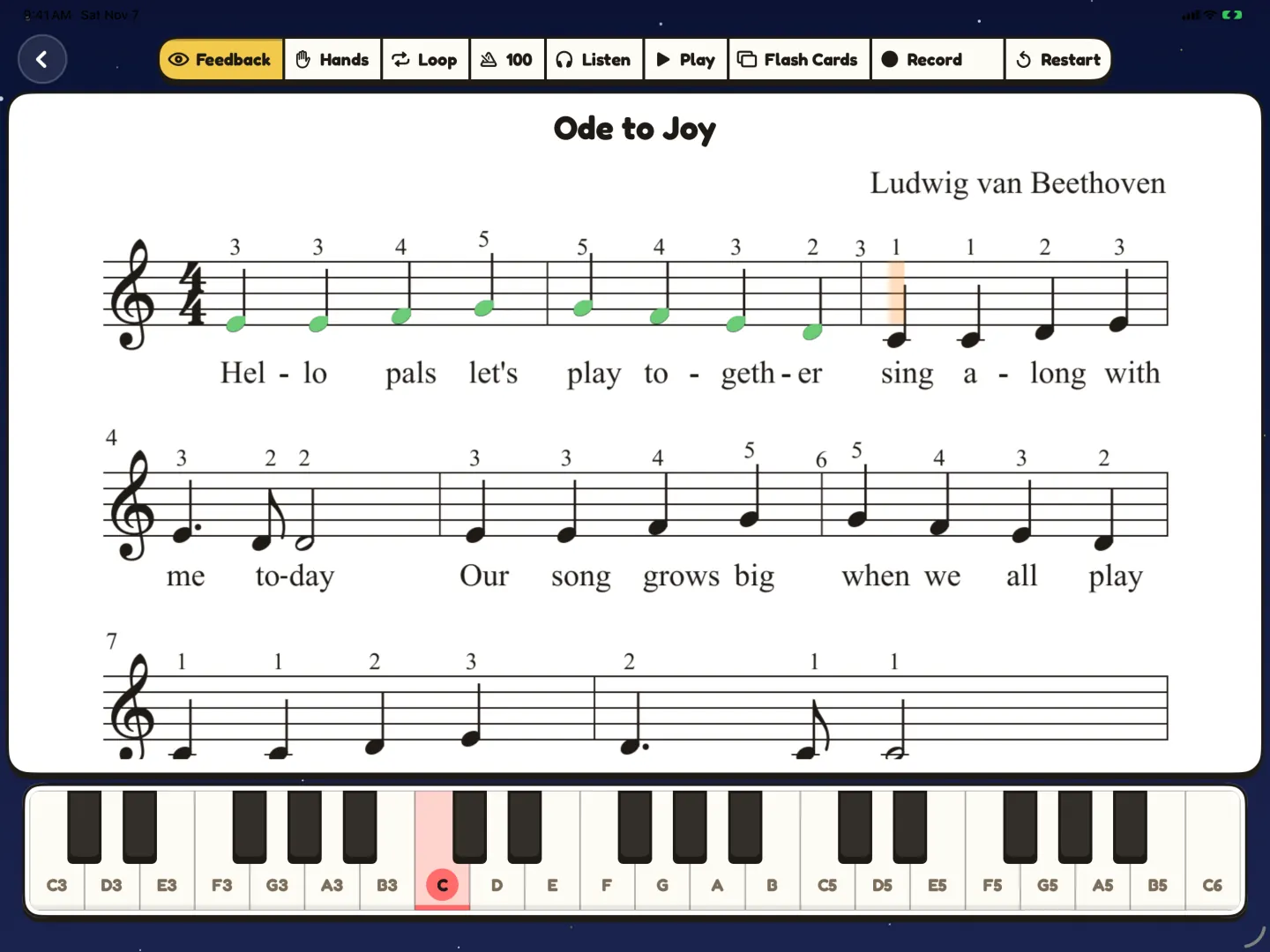
Sometimes the hard part is the move into a bar, not the bar itself. If so, include the last note of the bar before it in the loop.
How do I practice one bar in Pianu?
Here are the steps, from the smallest part to the whole piece:
- Open the song and start Practice.
- Turn on Loop and pick the hard bar range. One or two bars is enough.
- Slow the tempo. Pick a speed where your child can play the bar without stopping.
- Practice the harder hand alone. Your child plays one hand while Pianu plays the other.
- Switch to the other hand, still slowly.
- Play both hands together at the slow tempo.
- Bring the tempo up a little. Play the loop a few more times.
- Turn off Loop, and play from a bar or two before the hard bar to a bar or two after it.
The clip at the top of this post shows a loop on bars 3 and 4 of the sample song, played on the on-screen keys.
Stop each step when your child plays it right a few times in a row. It is fine to leave a step for tomorrow.
Which tool helps with which problem?
Different mistakes need different help. Use this table as a guide:
| What goes wrong | What to try in Pianu |
|---|---|
| Wrong notes in one place | Loop the bar range and slow the tempo |
| One hand is fine, the other is not | Practice that hand while Pianu plays the other |
| The fingers get stuck or cross | Ask for finger numbers, and check them with the teacher |
| The rhythm is uneven | Listen to the piece first, then look at the rhythm in the feedback |
| The bar is right alone, but not in the piece | Loop a larger range that starts one bar earlier |
If the fingers are the problem, read piano finger numbers for kids. The right fingers can make a hard bar much easier.
How long should we practice one bar?
Not long. A few minutes on one bar, with breaks, is enough for a young child. Short tries over several days are easier for a young child than one long fight today.
Watch your child, not the clock. When they get tired, they make more mistakes, and that is a good time to stop. End with something they can already play well, so practice ends on a good feeling.
The next day, start with a short warm-up on the hard bar. The bar can feel a little easier than it did yesterday.
Is the bar still hard after a week? Then look for a cause outside practice:
- If the song came from a scan, compare that bar with the printed page again. A wrong note in the scan can make a bar feel strange. Fix it in the editor.
- Check the fingers. A different fingering, chosen with the teacher, can change everything.
- Ask the teacher. They may simplify the bar for now, or give an exercise for the move that is hard.
It is also fine to leave the bar for a few days and practice the rest of the piece. Come back to it with fresh hands.
How do we hear the progress?
Record a take before you start working on the bar. In Pianu, you can save a take, play it back and share it.
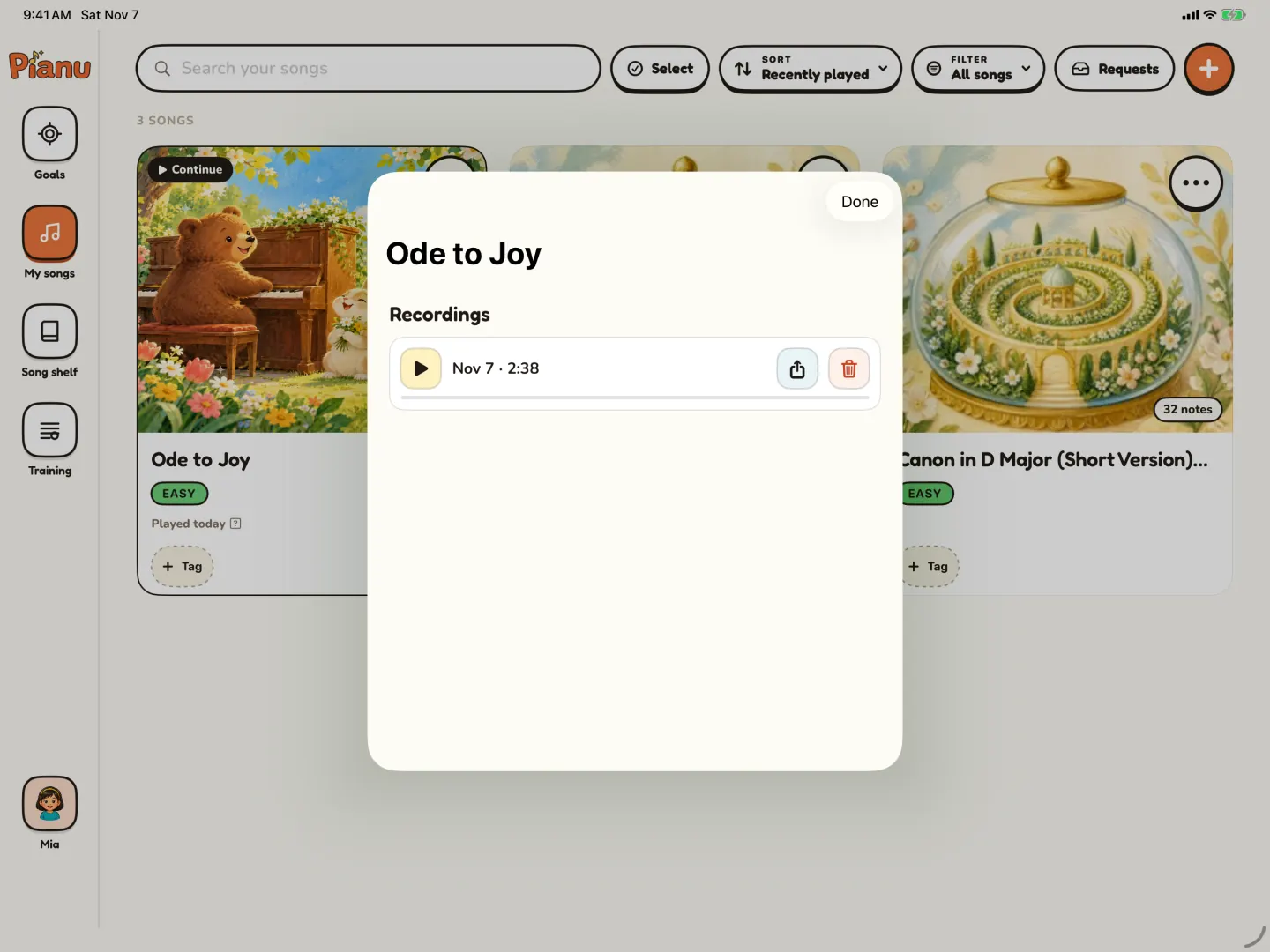
Record again at the end of the week. Play both takes to your child. Hearing the difference can be a big reward, and the teacher can hear it too.
For all the practice tools on one page, read the piano practice guide.
Read more: Practice guide
Questions parents ask
How many bars should we loop?
One or two. If the move into the hard bar is the problem, start the loop one bar earlier.
How slow is slow enough?
Slow enough that your child plays the bar without stopping. Then bring the tempo up a little at a time.
Which hand should we practice first?
The harder hand. In Pianu, your child can play that hand while Pianu plays the other.
What if the bar is still hard after a week?
Compare the bar with the printed page if the song came from a scan. Check the fingers, and ask the teacher for help.
Try Pianu free for 7 days.
Try free for 7 days